ASTR 222 - Homework #3
1. Population Synthesis
(You can code this one up in
Python, or alternatively an Excel-type spreadsheet would
work great for this problem, as well...)
We are going to make galaxies by mixing stars. Here are the four
types of stars we are going to use. For
each type of star, describe in words what kind of star it is: what
evolutionary stage it is in, what kind of lifetime it has, what limits
(if any) you can place on its age. Then calculate its stellar mass-to-light
ratio (M/L)*.
(Remember that
mass-to-light units are solar units, so the Sun has a mass-to-light
ratio of (M/L)* = 1 Msun/Lsun. And also remember
that the Sun has an absolute magnitude of Mv=4.8 and a B-V color of
0.65.)
|
Star 1
|
Star 2
|
Star 3
|
Star 4
|
Spectral Type
|
A2V
|
G2V
|
K5V
|
K2III
|
Mv
|
1.3
|
4.8
|
7.35
|
0.5
|
B-V
|
0.05
|
0.65
|
1.15
|
1.16
|
Mass (Msun)
|
2
|
1
|
0.67
|
1.1
|
(M/L)* (fill this in!)
|
|
|
|
|
Now let's build some galaxies. The galaxies should each have a
total V luminosity of Lv=1010 Lsun. The fraction
of V light
each star contributes to each galaxy is given in the table below. Calculate the total (aka "integrated")
B-V color and stellar V-band (M/L)* ratio, as well as
the fraction
of each
star by number for each model galaxy. Show your work, by walking
through one example by hand in exquisite detail.
|
Fraction
of V-band light from each star
|
|
Star 1
|
Star 2
|
Star 3
|
Star 4
|
Galaxy 1
|
15%
|
40%
|
25%
|
20%
|
Galaxy 2
|
30%
|
0%
|
0%
|
70%
|
Galaxy 3
|
45%
|
25%
|
20%
|
10%
|
Galaxy 4
|
0%
|
30%
|
70%
|
0%
|
Galaxy 5
|
0%
|
30%
|
50%
|
20%
|
Now, a "typical" color for a spiral galaxy like the Milky Way is
B-V=0.7, an elliptical might have a color of B-V=1.0, and a starburst
galaxy might have B-V=0.4. Which
of these galaxies is a good match for an elliptical, which for a
spiral, and which for a starburst? Which two galaxies don't make sense?
Argue your answer both from integrated colors and from the mix of
stellar types.
2. Disk Galaxies: Surface Brightness and Luminosity
This problem is being deferred to a later problem set.
- If a galaxy is observed face on (with no dust) and has a
surface brightness equivalent to one solar-type star per square parsec,
show that the surface brightness in
magnitudes per square arcseconds is mu=27.05 mag/arcsec2 in
the B band. From this, show that the
relationship between surface brightness and luminosity density is
mu(B)=27.05 - 2.5 log I, where I is the luminosity density of the
galaxy in solar luminosities per square parsec. If
a bright spiral galaxy has a central surface brightness of mu(B)=21.65 mag/arcsec2,
what is the luminosity density in its center? We are now discovering
really faint "ultradiffuse galaxies" that have central surface
brightnesses of mu(B)=27 mag/arcsec2 -- what does that correspond to in terms of luminosity density?
- If a disk galaxy has an exponential surface brightness
profile like this: I=I0exp(-r/h), where h is the scale
length and I0 is the central luminosity density, calculate:
- the total
luminosity of the galaxy (in terms of I0 and h)
- the half-light radius of the galaxy
- the radius containing 98% of the
total light.
3. The Tully-Fisher Relationship
- In class, we made arguments about why we might
expect L ~ v4 for spiral galaxies. Show analytically that if
we plotted absolute magnitude
against log(v), we would expect this line to have a slope of -10.
- In general, unless we know the distances
of
galaxies, we can't make a Tully-Fisher plot. But we can be crafty and
realize
that if we look at galaxies in a cluster we can plot apparent magnitude
against log(v) and get the same slope. Why?
So here is
a Tully
Fisher dataset for galaxies in the Virgo Cluster (from Pierce
&
Tully 1988, ApJ, 330, 579). The dataset has
- the NGC number of each
galaxy,
- apparent magnitude of the galaxies in the B, R, and I band,
- the inclination of the
galaxy to the line of sight (90o=edge on, 0o=face
on).
- the observed rotation speed
(W20/2) of the galaxies
- We need to make a
correction to the data based on inclination in order to get the true
rotation speed of
the galaxy. What would this correction
be?
Apply this correction to the observed rotation speeds to get the true
rotation
speed.
- Make
a
Tully-Fisher plot (apparent mag versus log(V)) in the B,
R, and I bands, and
for each case, fit a line of the form m=a*(log(V)-2.5)+b. Report your
fit
by giving the parameters a and b as well as their uncertainties.
- What is the slope of
the
line in each case? When is it closest to the "expected" value?
- What is the
dispersion around the line in each case?
- Give physical
arguments
about which band would best define the Tully-Fisher relationship. Think both about stellar populations and dust.
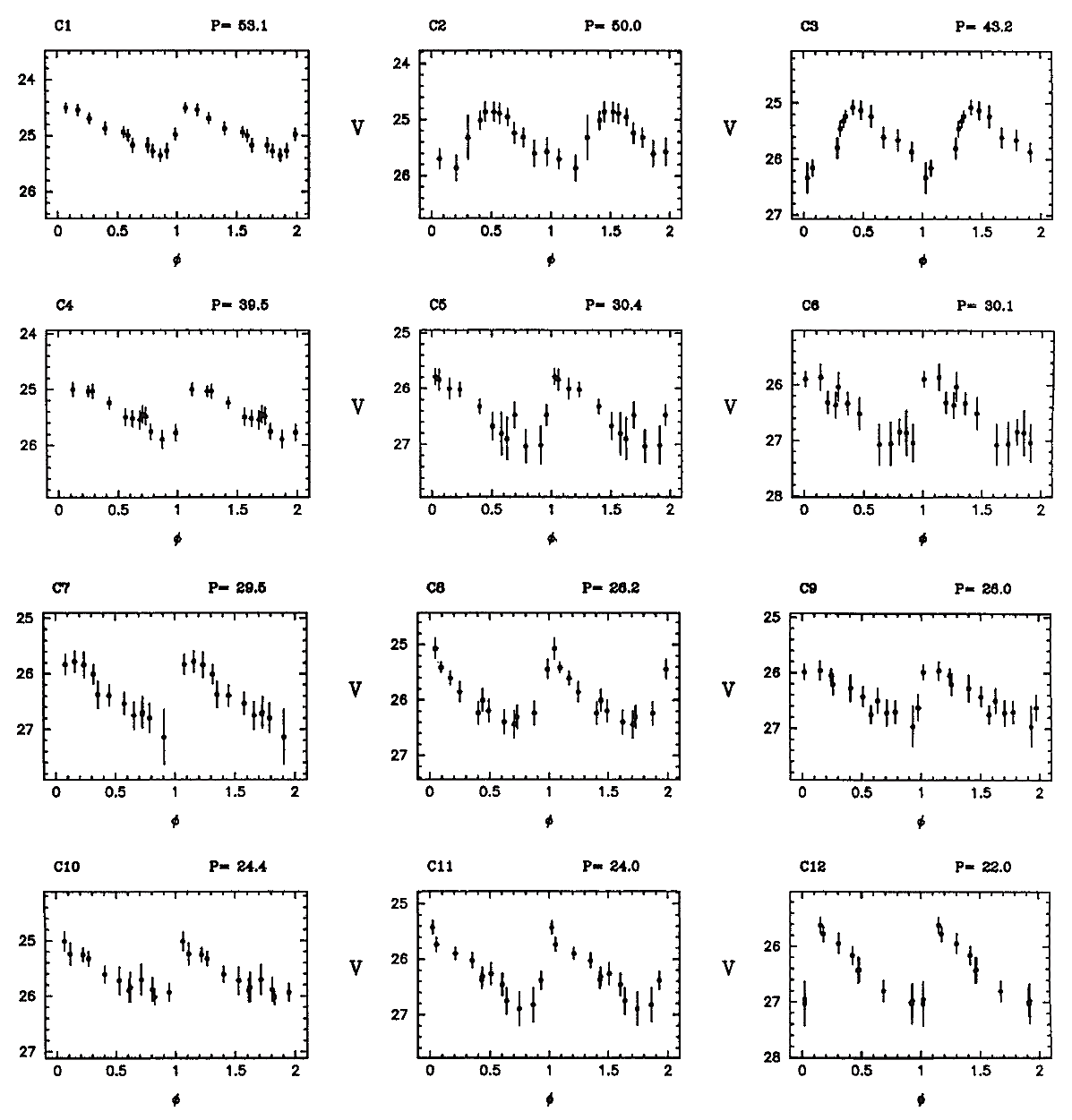
Now we need to calibrate the
Tully-Fisher relationship. We want to know how absolute magnitude
depends on circular velocity,
which means we need to know a distance to the Virgo cluster. Using the
Hubble
Space Telescope, we observe Cepheid variables in M100, also known as
NGC
4321. Here are the reduced light curves
(from Freedman etal 1994, Nature, 371, 757). These are plots (one
for each detected Cepheid) of apparent magnitude on the y-axis and time
in days ("phi") on the x-axis. The derived period is shown in each
frame as "P=xx".
Using the Cepheid
period-luminosity relationship given
in class -- (M=-2.43*log(P)-1.62) -- calculate a distance estimate to
M100 for each Cepheid and then average them to give your best estimate
for the M100 distance. Also give a statistical uncertainty to your
distance.
- Using
this distance,
calibrate the Tully-Fisher relationship. You had a T-F relationship
that connected apparent magnitude (m) with logV, and now you know the
distance to Virgo to turn apparent magnitude (m) into absolute
magnitude (M), so you can rewrite your T-F relationship now in terms of
absolute magnitude: M = a*(log(V)-2.5) + b. What are a and b, and their uncertainties?
- What do you feel
are the main sources of uncertainty, both systematic and random, in
your derivation of the T-F
relationship?
- Now you are looking at a
spiral galaxy in the Coma cluster. It has an I-band apparent magnitude
of 13.5, an
observed rotation speed of 180 km/s, and an inclination of 65o
. What is the distance to Coma? What
is
the uncertainty in your distance?