Astr/Phys 328/428 Homework #1
1. Volume of the
Universe
Step 1: Find
the volume of the
Universe out to a comoving distance r. Using the Robertson-Walker
metric, we can define the differential volume element as
which means the volume out to a comoving distance r is given by
Solve to get an analytic expression for V(r) for k=-1,0,1.
Step 2: Find the relationship between comoving distance r (which you've
calculated the volume for, but is unobservable) to redshift z (which is
observable).
Start by using the R-W metric and integrating along the path of a light
ray. Do this exercise
using a flat, matter dominated OmegaM=1 universe, remembering that R(t)~t2/3 in such a universe. While
this cosmology is certainly not the correct one, it is a useful
"benchmark" to compare to (and it is analytically tractable!). This
should give you a relationship
like this: r=f(R,t0). Then use the Lemaitre equation and the expression for t0 to turn it into
r=f(z,H0).
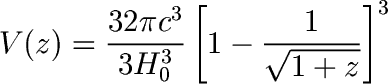
Step 3: Combine the relationship
in steps 1 and 2 to show that
- V(z) is different in different universes. For
example, using the same techniques, but with messier math, we can show
that for an empty (i.e., non-Lambda, OmegaM=0) universe, the volume is
While for positively curved, OmegaM=2 universe
we have

- On one figure, plot the volume (in Mpc3) out to
a redshift z
in each universe, from z=0 to z=3. Use H0=70 km/s/Mpc for these
calculations and also overplot the
volume in a LCDM universe with OmegaM=0.3 and OmegaL=0.7. The easiest way to do this is with the astropy.cosmology package, but for those who don't use astropy, here is a table of the volume (in Mpc3) as a function of redshift in such a universe.
- If the distribution of galaxies in the universe
is completely
homogeneous (meaning the number of galaxies per unit volume is a constant everywhere), plot on one plot the
relative number of galaxies you see (per unit redshift) at a redshift z as a function
of redshift in each of those four cases.
- If you could see all bright galaxies in the universe out to a
redshift of
z=2, what would the median
redshift of the galaxies be in these four universes? Explain
qualitatively why this makes sense.
- Why is this test (called the count-redshift
test) a
difficult
test to perform? Think about observational issues, as well as the underlying physical assumptions behind the test.
2. The Flatness of the Universe
Starting with the Friedmann equantion for a Lambda=0 universe, show that the Hubble parameter can be written as:

Helpful hints:
- First, rewrite H in terms of rho0 and z.
- Then rewrite rho0 in terms of Omega0 and H0.
- Then rewrite the Friedmann equation as it is at z=0.
- Then combine together what you get via those three hints to get the expression we want.
Then use that to show that

Helpful Hints:
- Start with writing Omega in terms of rho and H.
- Then substitute for H using the
expression you derived in the first part of the problem, and also
rewrite rho in terms of rho0 and z.
So we see that Omega varies with time. Now do the following:
- At large redshifts (ie in the early universe), show that the
Universe is essentially flat for any plausible choice of Omega_m0. Does
this argument also hold for universes with a cosmological constant?
Explain.
- Take your expression for Omega(z) and rewrite it so that you
have an expression for Omega_m0 as a function of Omega(z) and z.
Calculate what Omega_m0 would be if, at a redshift of z=1000, Omega had
the value of 0.95, 1.000, or 1.001. What does this suggest about the
value for Omega_m0?
3. Apparent Magnitudes and sizes of distant objects
In Lambda=0
universes, the "luminosity distance" (ie the distance measure you use
when calculating brightnesses of objects) can be expressed
analytically, and is given by
 The giant elliptical galaxy M87 has a V band luminosity of 1011 Lsun
and an effective radius of about 10 kiloparsecs. Imagine moving M87 to
different redshifts, and plot its apparent V magnitude as a function of
redshift from z=0.1 to z=2.0 for universes with q0=0.1, 0.5, and 1.5.
Ignore K-corrections for this calculation, but describe qualitatively
what the K-correction will do to your plot. Also, explain qualitatively how these universes differ in terms of their expansion history and spatial curvature.
The giant elliptical galaxy M87 has a V band luminosity of 1011 Lsun
and an effective radius of about 10 kiloparsecs. Imagine moving M87 to
different redshifts, and plot its apparent V magnitude as a function of
redshift from z=0.1 to z=2.0 for universes with q0=0.1, 0.5, and 1.5.
Ignore K-corrections for this calculation, but describe qualitatively
what the K-correction will do to your plot. Also, explain qualitatively how these universes differ in terms of their expansion history and spatial curvature.
Make a second plot showing the angular size of M87 (in arcseconds) as a function of redshift over that same redshift range.
For each of these different universes, answer the following:
- If you were constructing a sample of galaxies
brighter than mV=20, at what redshift would an M87-type galaxy no
longer be included in your sample?
- If you were constructing a sample of galaxies with angular sizes greater than 1.5 arcsec, at what redshift would an M87-type galaxy no longer be included in your sample?
4.
Distant objects
Do
this calculation twice. Once analytically for a OmegaM=1, OmegaL=0
universe (show your work!), and then use the astropy cosmology calculator or the Cosmology Calculator to get the
values for a OmegaM=0.3, OmegaL=0.7 universe. Compare how the values differ in the different universes.
One of the most distant radio galaxies is 8C 1435+63, at a redshift of
z=4.25. Answer the following:
- How old was the universe at this redshift? Give the answer
both in years and in fraction of the age of the universe today.
- What is the present proper distance in Mpc?
- What was the proper distance when the light we see was
emitted?
- What is the luminosity distance?
- What is the angular size distance? If the angular size of
the galaxy is 1", what is the galaxy's physical size (in kpc)?
ASTR 428 additional question:
5. Lookback Times and Age Constraints
Use either the astropy cosmology package or the Cosmology Calculator for this exercise.
- It's 1990. You are a good, party-line
cosmologist
and "know"
that OmegaM=1, and that there is no such thing as the cosmological
constant.
You also "know" that globular clusters are 14-16 Gyr old. What can you
say about H0?
- A few years later, you decide that the
measurements of H0
are getting better, so you need to believe them. So take H0=55, and
tell
me what constraint you can place on OmegaM. What about if you believe
H0=65?
H0=75?
- And then Hipparcos comes along (around 1997)
and
tell us
that GCs are further away -- this means the ages of the globular
clusters get revised
downwards to 11-13 Gyr. Why does
the further distance mean a younger age? At the same time, you
decide, for better or worse,
that you like H0=65. Now what
constraints can you place on OmegaM?
- Later, in 1998 the high redshift galaxy
LBD53W091
was discovered.
It lives at a redshift of z=1.55, and its was determined to have a
minimum
age of 3.5 Gyr. How does this
change your constraints on OmegaM?
- Six months later, the age of LBD53W091 was
revised downwards,
and became 1.7 +/- 0.3 Gyr. NOW
how do your constraints on OmegaM change?
- Finally, this wacky Lambda idea starts to
take
off, so you
have to consider OmegaL as well. Given
your GC ages and H0, pick values
of OmegaL and, for those values, place limits on OmegaM. Make a plot of
your results on an OmegaL-OmegaM plane, showing regions of "allowed
cosmology" given
your GC age constraints.