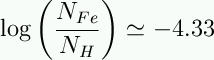
 so that for
every Iron atom there are 20,000 Hydrogen atoms.
so that for
every Iron atom there are 20,000 Hydrogen atoms. |
|
|
|
|
|
|
|
|
|
|
|
|
(C, O, Mg, Si, Fe, etc: "metals") |
|
|
and we define these quantities such that X+Y+Z=1
A different way of measuring a star's chemical composition is by the Iron(Fe)-to-Hydrogen(H) ratio:
for the sun, so that for
every Iron atom there are 20,000 Hydrogen atoms.
We measure this value for other stars relative to the sun using a quantity called [Fe/H]:

Defined this way the Sun has a metallicity 
Question: What does it mean to have a metallicity:
In the 1940s, Walter Baade introduced the concept
of stellar populations:
|
|
|
|
|
|
|
|
|
|
|
|
So any model for how the Galaxy formed and evolved must
explain why there are different populations of stars in
different parts of the Galaxy.
|
Note that metallicity also correlates with color:
Why?
So lots of things affect colors:
|
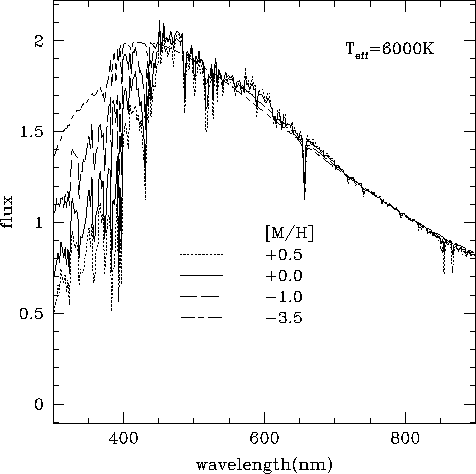 Example of line blanketing
|