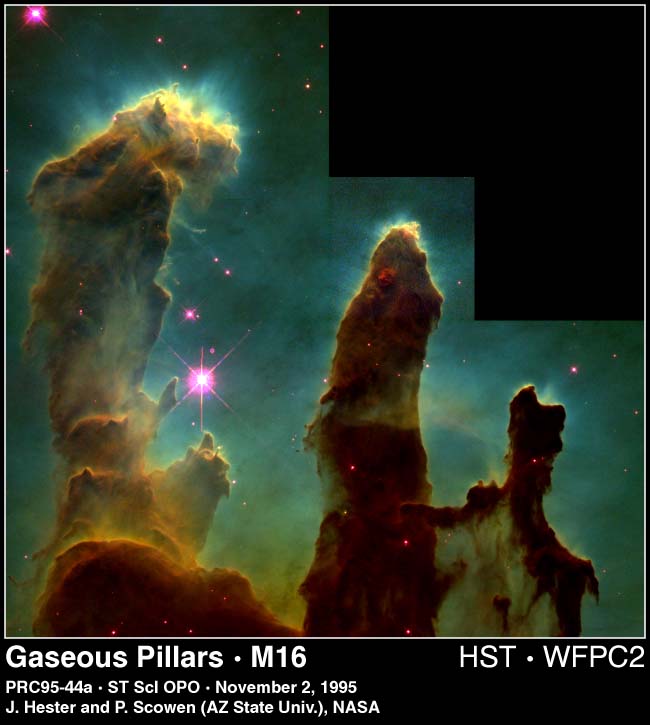
The Interstellar Medium
or "the stuff between the stars"
Interstellar space is not empty -- there is lots
of gas and dust in the galaxy. Dust
we
talked about -- its presence causes an extinction and
reddening of starlight that passes through it. What about this
gas stuff?
The chemical composition of the gas is mostly
hydrogen (~70%), a little bit of metals (~ few %) and the rest
helium. What does this sound like?
Depending on the physical conditions around the
gas, it can be either
- neutral hydrogen (HI)
- ionized hydrogen (HII)
- molecular hydrogen
(H2)
mixed with the helium and metals, of course... How
do we see this gas? Because it is diffuse, it does not act like a
blackbody, so we don't see a continuous spectrum (like stars).
Ionized hydrogen
("HII regions")
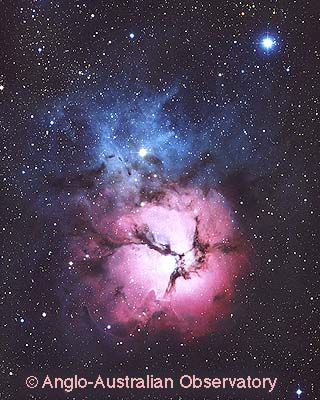
Near hot stars, the intense UV
light can ionize the hydrogen atoms. When the electrons
and protons recombine, they generally recombine to upper
energy levels (large n), and then cascade down, emitting
Balmer lines. Then they can be reionized, and the cycle
continues. So we see Balmer emission lines, as well as
lines from other atoms (ie oxygen, sulfer, silicon,
carbon...).
These HII regions are
associated with regions of active star formation. Why
do we know there are young stars there?
|
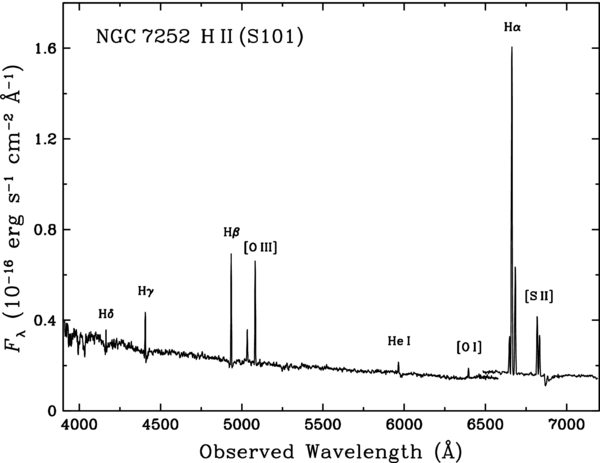
(From Schweizer et al 2013)
|
 |
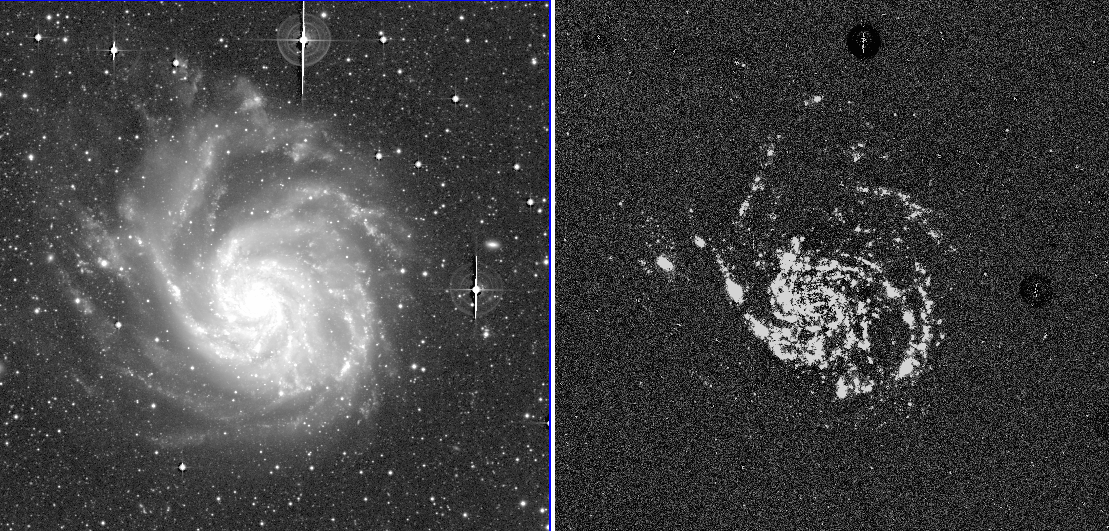
In galaxies, HII regions trace star
formation
Left: M101 B image showing stars (Mihos et al 2013), Right: M101 H image
showing star forming regions (Watkins et al in prep):
Neutral hydrogen (HI)
Far away from stars, there is nothing to
ionize the gas, or even excite the electrons to higher energy
levels. The hydrogen is in the ground state (n=1), so there are
no downward transitions to make emission lines. How then can we
see this gas?
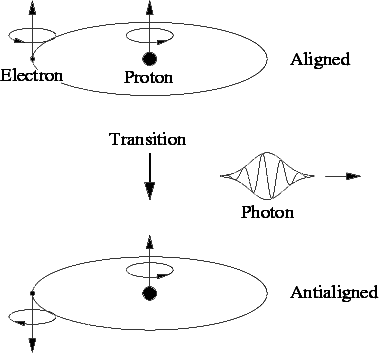 |
Atomic physics: particles have
angular momentum (spin, described by the quantum number
m). Because they have charge, and are spinning, they act
sort of like little magnets. The electron and proton want
to be anti-aligned so that they have opposite spin -- this
is their ground state. If they are aligned, they have
slightly more energy; they can change their spin and
release this energy difference as a photon.
The energy difference is small - about
6x10⁻⁶ eV. This corresponds to a wavelength
of 21 cm -- radio waves!
|
How often does this happen? For a given atom,
about once every several million years. But if you have enough
atoms...
What happens if we look at M101 in 21-cm radio
emission?
Left: M101 B image showing stars (Mihos et al 2013),
Right: M101 21-cm image showing neutral hydrogen (THINGS
team):
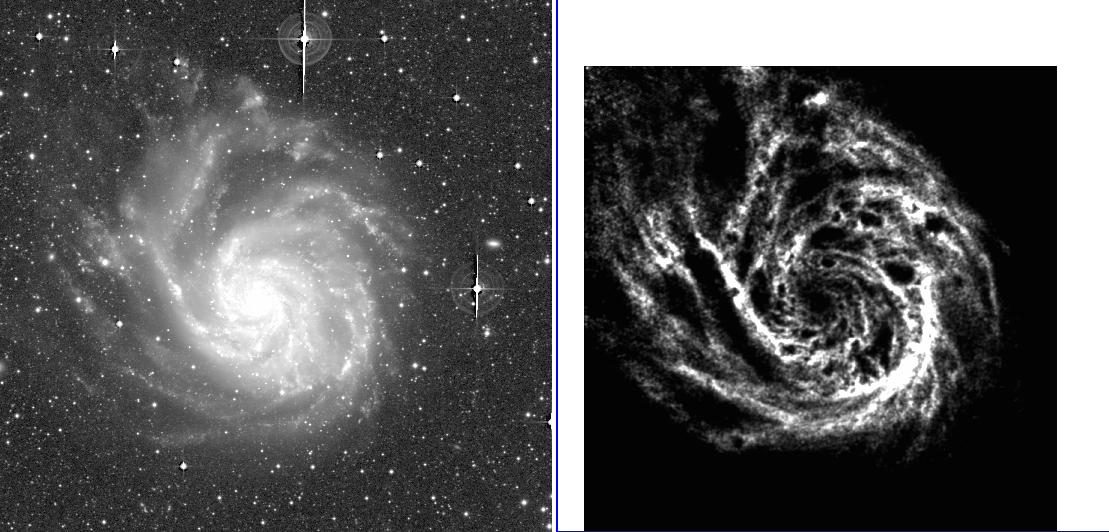
So there's lots of gas out there. In our
galaxy, there is about 1 solar mass of gas for every 10 solar
masses of stars.
Molecular gas
If the density of the gas is high, and
the temperature is cold enough, hydrogen atoms can form molecular hydrogen (H2).
Unfortunately, there is no emission from H2 in the optical or
radio bands -- it is very hard to observe. How can we see it?
1. Look at other
molecules (where you have one molecule, you'll
probably have others). For example, CO emits radiation at a
wavelength of 2.6mm -- microwaves!
Look at the nearby galaxy M51:
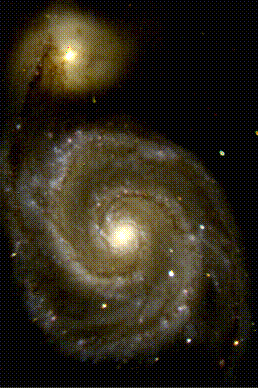
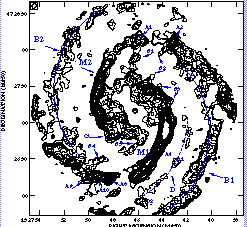
2. Look for dust.
Dust and molecules are often found together (why?)
Dense, dark clouds (called Bok
globules) are regions of very dense molecular
gas.
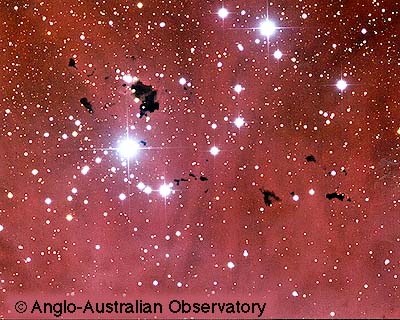
Where we see lots of gas -- in particular
molecular gas and ionized gas -- we see lots of stars
forming...