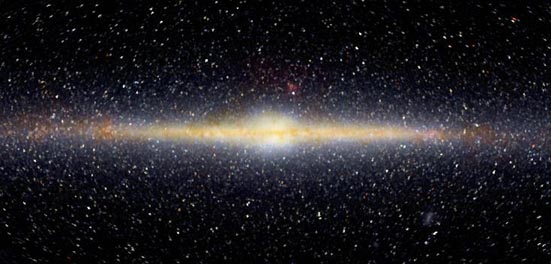
 As you go closer to the center of the
Milky Way, the distribution of stars becomes vertically thicker.
This is not an actual thickening of the disk, but rather a sign of
a different component of the galaxy - the galactic bulge.
As you go closer to the center of the
Milky Way, the distribution of stars becomes vertically thicker.
This is not an actual thickening of the disk, but rather a sign of
a different component of the galaxy - the galactic bulge.
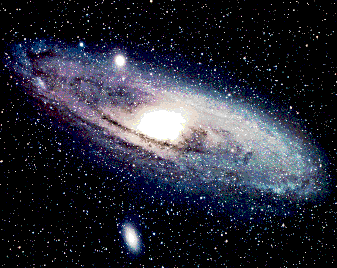
Disk galaxies often have central bulges -- look
at the nearby Andromeda galaxy, for instance.
|
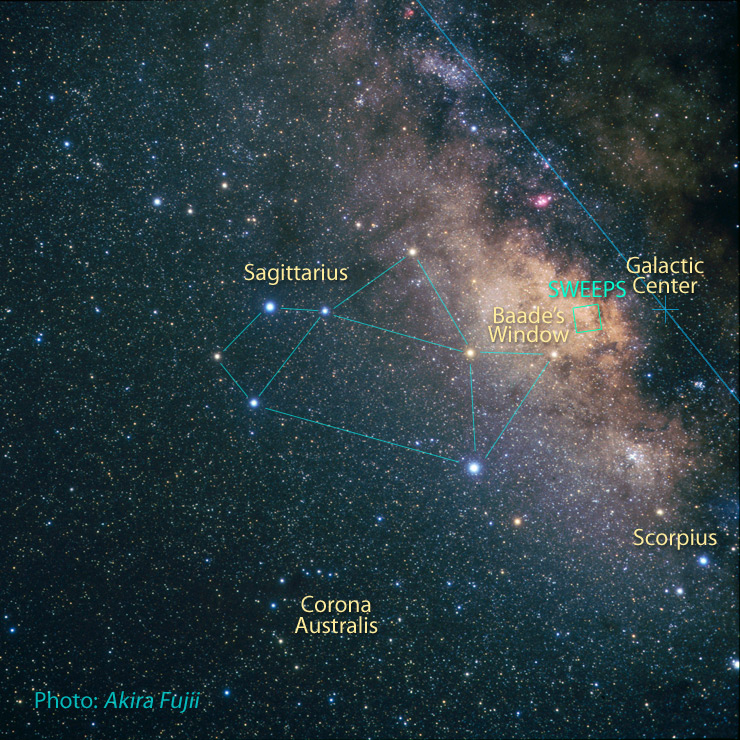
It's hard to study the galactic bulge due to dust -- as much as 28 magnitudes of extinction exist within a few degrees of the center. But the dust is patchy, and there are holes which we can peek through, such as Baade's window. The line of sight through Baade's window passes within 500 pc of the galactic center, so we can study bulge stars. Bulge stars are mostly old (ages > 9
Gyr) and have a range of metallicities (-1 < [Fe/H]
< 0.5) with an average metallicity a little under
solar ([Fe/H] = -0.2). There is evidence for a complex
formation history. |
 |
|
Unlike the disk, the distribution of
stars in the galactic bulge is not exponential. It was
once thought to be spheroidal, with an effective radius - the
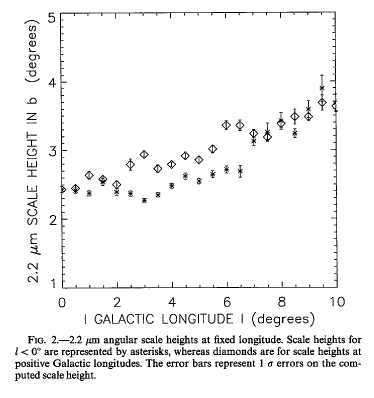
radius which contains half the light - of a few kpc. However, recent results indicate that the bulge is not spheroidal, but is more likely bar shaped. Infrared data show that if you look on one side of the galactic center or the other, on one side the bulge appears bigger in angular size, and on average the stars are closer to us than on the other side. This can't happen if the bulge is axisymmetric!Instead live in a galaxy with a central bar, a few kpc in extent. Disentangling bar from bulge is tricky and perhaps not even correct -- some astronomers argue we may not have a classical central bulge at all. Bulge or bar, the mass of the inner structure is about 1010 Msun , or about 1/6 that of the disk. |
 |