Cepheid Distances
Cepheids are a
type of variable star named after the archetype, Delta Cephei,
which varies by a magnitude or so over a well defined period of
5.367 days.
|
Henrietta Leavitt
(1868-1921) compared photographs of various parts of the sky,
taken on separate occasions, to identify variable stars. She
discovered many Cepheids, most in a nearby small companion
galaxy known as the Small Magellenic Cloud. She noted that the
brighter ones took longer to change brightness:
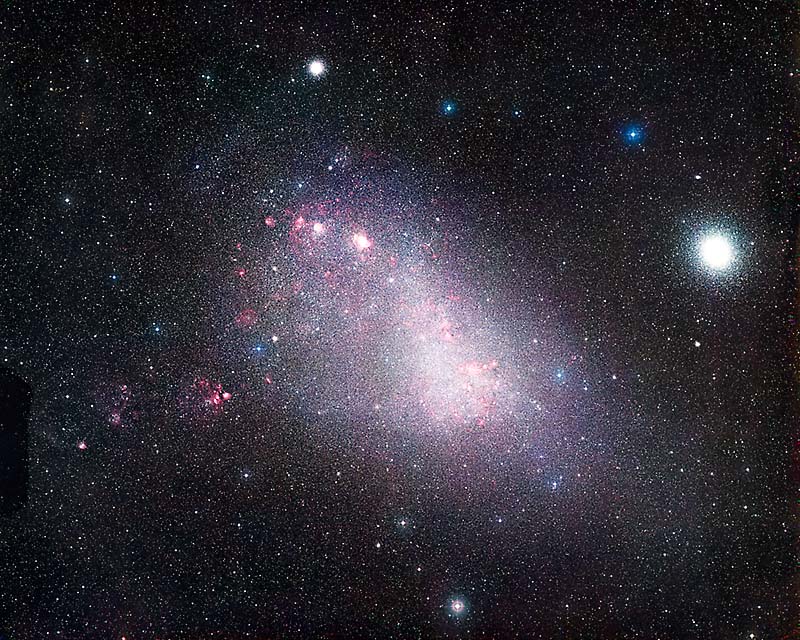
Small Magellenic Cloud
|
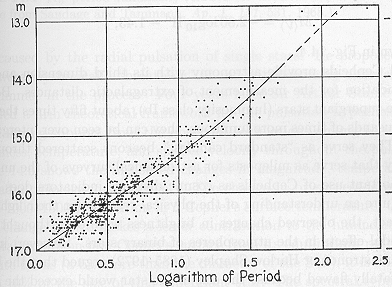 Cepheid variables in the SMC Cepheid variables in the SMC
|
|

Henrietta Leavitt
|
Since all the Cepheids in the SMC are (just
about) at the same distance, the fact that the brighter ones
have longer periods means that period and luminosity are
related. If we could find the distance to a Cepheid somehow, we
could derive a relationship between period and absolute
magnitude which we could use as a distance indicator.
Cepheids are rare stars, and so they are typically far away and
we don't have parallaxes for many. Some Galactic Cepheids have parallaxes from the
Hubble Space Telescope, so their luminosities are accurately
known, others we can get distances for using main sequence
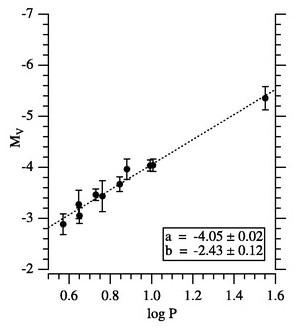
fitting or other distance measures. This lets us derive the Cepheid period-luminosity relationship.
|
HST Parallax Cepheids
Benedict et al (2007)
MV = -2.43[log(P) - 1] - 4.05
or
MV = -2.43log(P) -1.62
(remember, in this expression,
period is measured in days)
|
So, once we have a calibrated relationship,
if we find a new Cepheid and derive its period, we can then
immediately calculate its absolute magnitude. Then, having
observed its apparent magnitude, we can calculate the distance.
Advantages:
- Cepheids are bright (1000x the Sun) -- we
can see them even in other (relatively nearby) galaxies
- Cepheids are driven by
stellar pulsation, which is fairly well understood.
Disadvantages:
- They are relatively rare
- Their period also depends on their chemical composition (actually a P-L-Z relationship).
How do we know they are pulsating stars? Look at
their change in brightness, temperature, and radial velocity:
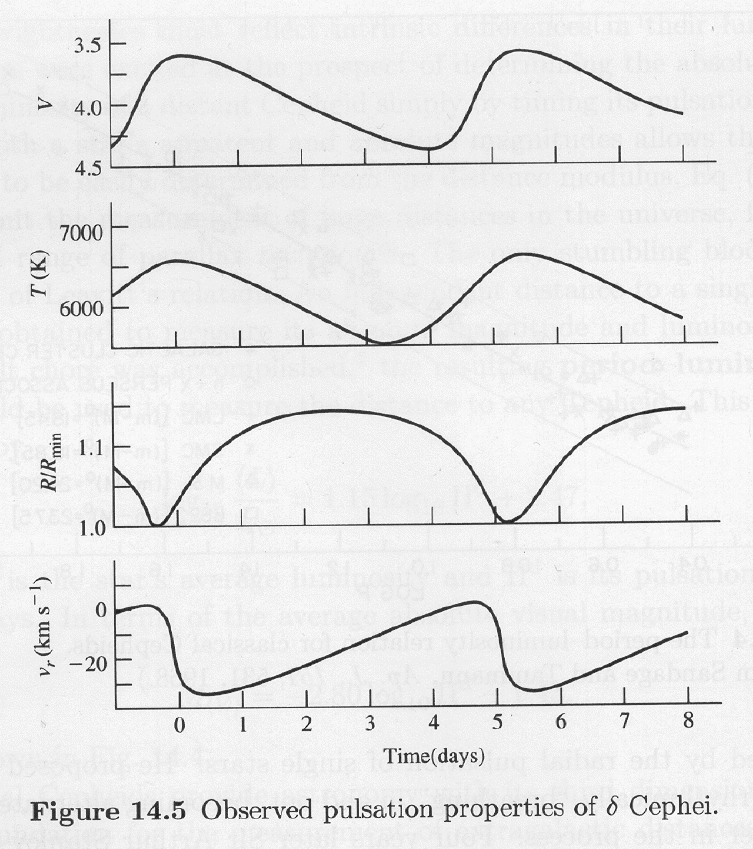 So Cepheids are brightest
when they are hottest, and
when they are smallest. Does
this make sense?
So Cepheids are brightest
when they are hottest, and
when they are smallest. Does
this make sense?
What kind of stars are these? Look at their
positions on the H-R Diagram, and plot models of stellar evolution
as well:
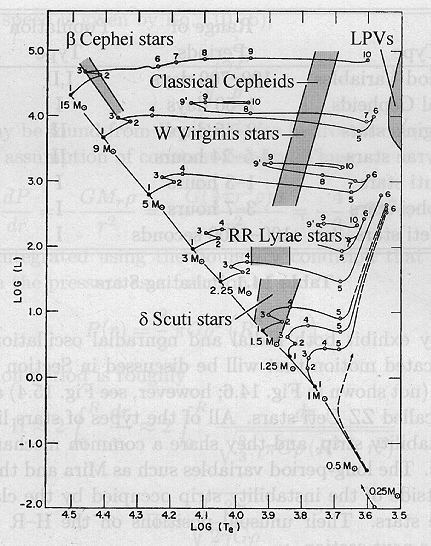
Cepheids are evolved
high mass stars!
There are other types of pulsating stars, which
define an instability strip
on the H-R diagram:
- W Virginis stars
(metal-deficient, under luminous Cepheids)
- RR Lyrae stars
(evolved low mass stars on the horizontal branch)
- Delta Scuti stars
(evolved F stars a bit more massive than the Sun)
- ZZ Ceti stars
(pulsating white dwarfs)